30 September 2026
What Happens When a Social Media Platform Refuses to Pick a Side?
Read more

Events and Campaigns
Most social media platforms treat people like a retention problem.
How do we keep users scrolling longer?
How do we maximise engagement?
How do we extract more attention?
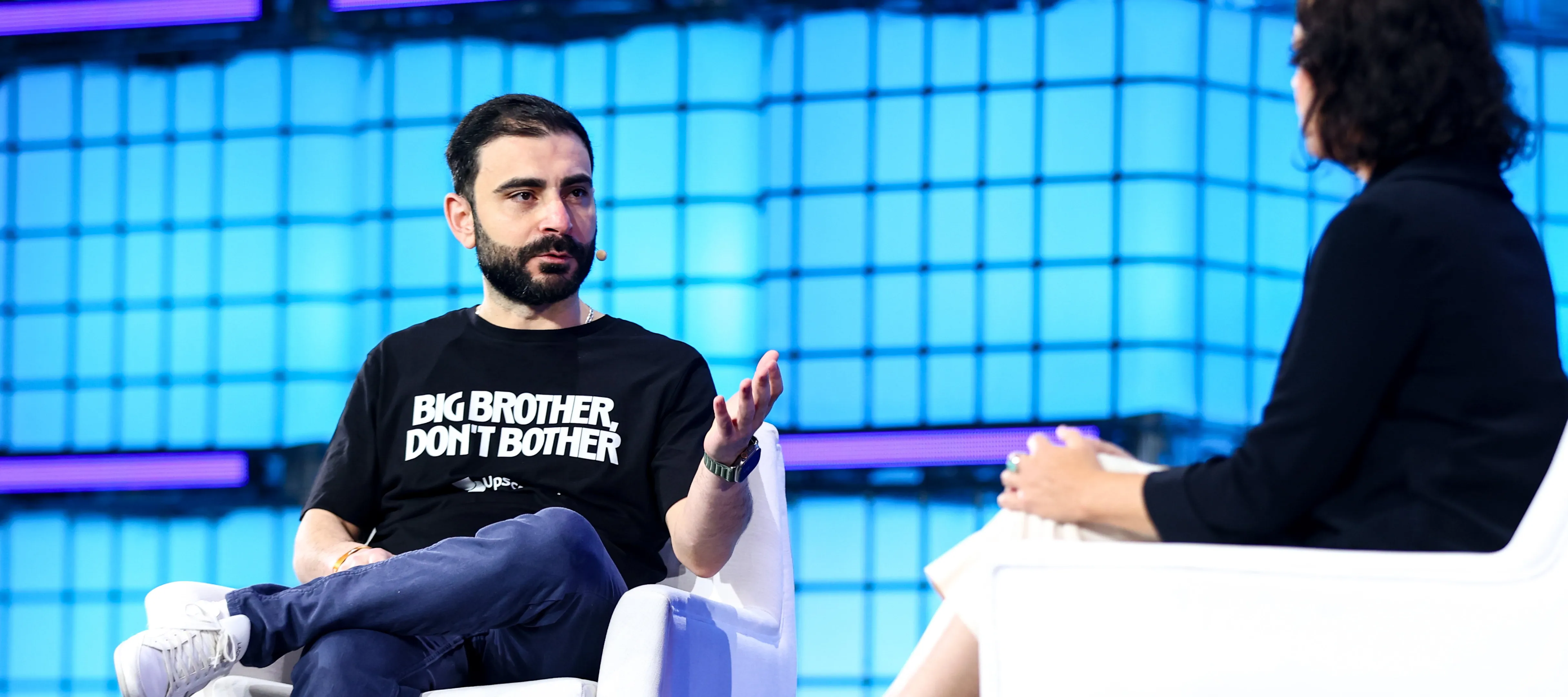
Issam Hijazi, UpScrolled Founder & CEO, took to the main stage at Web Summit Vancouver (11-14 May, 2026), for a conversation with The Guardian’s Dara Kerr that went beyond product and platform. The question on the table: whether the entire model modern social media has been built on is collapsing under the weight of public distrust.
The fireside chat began by exploring the rapid rise of UpScrolled, now approaching six million users globally. But the conversation moved quickly beyond startup growth and into a much wider critique of the systems shaping online life itself: surveillance-driven business models, invisible censorship, algorithmic manipulation, and the concentration of digital power inside a handful of tech companies.
“What triggered me personally is the genocide that started about two and a half years ago in Gaza,” Hijazi said. “I saw systematic suppression of voices across social media platforms, and I couldn’t continue working in that environment anymore.”
That breaking point eventually became UpScrolled.
Throughout the session, Hijazi spoke openly about watching social platforms evolve from community spaces into systems increasingly built around behavioural engineering, outrage amplification, and dependency loops designed to keep people consuming and scrolling endlessly.
“People are sick and tired of existing social media platforms,” he said. “Existing platforms have been systematically suppressing people’s voices.”
The conversation repeatedly returned to one central tension: who actually controls online discourse now, and whether users still trust the companies shaping it.
At times, the fireside chat stopped feeling like a conversation about launching another platform and became something much bigger: a challenge to the assumptions Big Tech has spent years conditioning people to accept.
Hijazi also pushed back hard against the idea that innovation, influence and legitimacy must continue flowing through Silicon Valley.
“Talent is not only in the US,” he said. “Capital exists outside the US. Community exists outside the US.”
The line landed sharply inside an industry still overwhelmingly dominated by American platforms, investors and gatekeepers.
That rejection of traditional platform logic now sits at the centre of UpScrolled’s positioning. A chronological feed replaces recommendation algorithms. Human moderation remains central to platform decisions. AI-generated content is labelled rather than quietly amplified. User data is not sold to third parties.
“We don’t want to build an addiction loop,” Hijazi explained. “We want people to feel in control again.”
The discussion became particularly charged when the conversation turned toward censorship, political visibility and the illusion of neutrality inside large tech companies. When questioned why Israel does not appear on UpScrolled, Issam did not reach for a safe answer.
"You go to Google Maps and put Palestine," Hijazi said, "and you will not see Palestine. That is a business decision." His point was not equivalence. It was exposure. Platforms make political choices. Most simply hide them.
"I'm a Palestinian person," he continued. "I see Israel as an ethnostate, an apartheid state that massacres people on the ground and continues to genocide my people. They don't recognise us as a people. They don't see us as people who deserve to have a country, or to even exist. So why should I recognise a country on my app that I've built, just for the sake of it?” He was clear that this is a deliberate decision, made without apology.
Underneath the wider political and technological debate, there was also something unexpectedly personal running through the session. Hijazi reflected on spending nearly two years building the platform alone while people around him dismissed the idea as unrealistic.
“I locked myself in my man cave for almost two years,” he admitted. “I built the backend, the frontend, the moderation systems, the streaming infrastructure. I didn’t even tell people because they would have told me to stop.”
Still, despite the heaviness of many of the themes discussed, the atmosphere inside the room refused to tip into cynicism. If anything, the session reflected something becoming increasingly visible across the tech landscape: people are no longer just frustrated with existing platforms. They’re actively searching for alternatives.
When Hijazi spoke about UpScrolled’s growth from 150,000 users to millions globally, it landed less like startup hype and more like evidence of a wider cultural shift already underway.
“Within one week, we became the number one app across multiple countries,” he said. “No paid ads. No marketing push. Just people choosing differently.”
At Web Summit Vancouver, many founders spoke about the future of tech.
This conversation questioned whether Silicon Valley should still be trusted to build it.
Watch the full interview here (starts at 24:55)
Download UpScrolled:
Your browser does not support the video element.
30 September 2026
29 September 2026
1 September 2026
20 August 2026